
In the US, food waste is estimated to be at 30% to 40% of the food supply (USDA ERS). At the same time, millions of people are food insecure, underscoring the need for better ways to recover and redistribute surplus food.
For cities and municipalities, it's an opportunity to reduce food waste, build local food systems, and connect food businesses with the communities that need them. So where do you start?
Read the full article to find out five practical steps that cities can take to build up more effective food recovery programmes.
Why Cities Play a Critical Role in Food Recovery
Cities are in a unique position to bring together the range of stakeholders necessary to make food recovery work at scale. By working with restaurants, grocers, food distributors, food banks, and various nonprofits, local governments can build a much stronger network to recover and redistribute surplus edible food.
Beyond facilitating food donations, municipalities can help address some of the biggest operational challenges in food recovery, including transportation, coordination, access to local partners, and impact measurement.
Washington State is a good example of the opportunity that lies ahead. The Washington State Department of Ecology's Use Food Well Washington Plan puts the state's annual food waste at around 1.2 million tons on its 2015 baseline. Over 390,000 of those tons are edible.
With the commercial sector responsible for about 60% of total food waste, there's a huge opportunity for cities to involve local businesses in food recovery.
Washington has also established ambitious food waste reduction targets:
● Recover at least 20% of the edible food which was disposed of in 2015 for human consumption by 2025.
● Reduce edible food waste by at least 195,032 tons by 2030.
● Reduce total food waste by at least 579,373 tonnes by 2030.
● Reduce the amount of organic waste going to landfill by 75% on a comparison to 2015 levels.
Based on the published edible food baseline the 2025 recovery target is approximately 78,012 tonnes per annum. That's a derived figure rather than a separately measured recovery outcome.
These targets show that food recovery is a key element of the state's wider sustainability strategy.
But getting there requires much more than just encouraging food donations. You need coordinated programs, solid partnerships, transport infrastructure and the ability to measure outcomes.
So what can the local authority learn from these figures, and how can it turn its food recovery ambitions into tangible programmes?
Understanding the Economic Value of Rescued Food
One of the most important opportunities for cities is recognising that recovering edible food creates value beyond reducing landfill waste.
Washington's published municipal solid waste tipping fees show that disposal costs vary dramatically across the state, from $44 to $400 per ton in the 2023 data set.
The unweighted average of the 44 published per-ton rates was c. $134.
When a ton of edible food is successfully recovered before disposal, the corresponding landfill gate fee is avoided.
But the disposal savings are only one element of the equation.
According to Feeding America's FY2025 audited financial statements, donated food has an estimated wholesale value of $1.90 per pound.
Based on this valuation, one ton of rescued edible food represents:
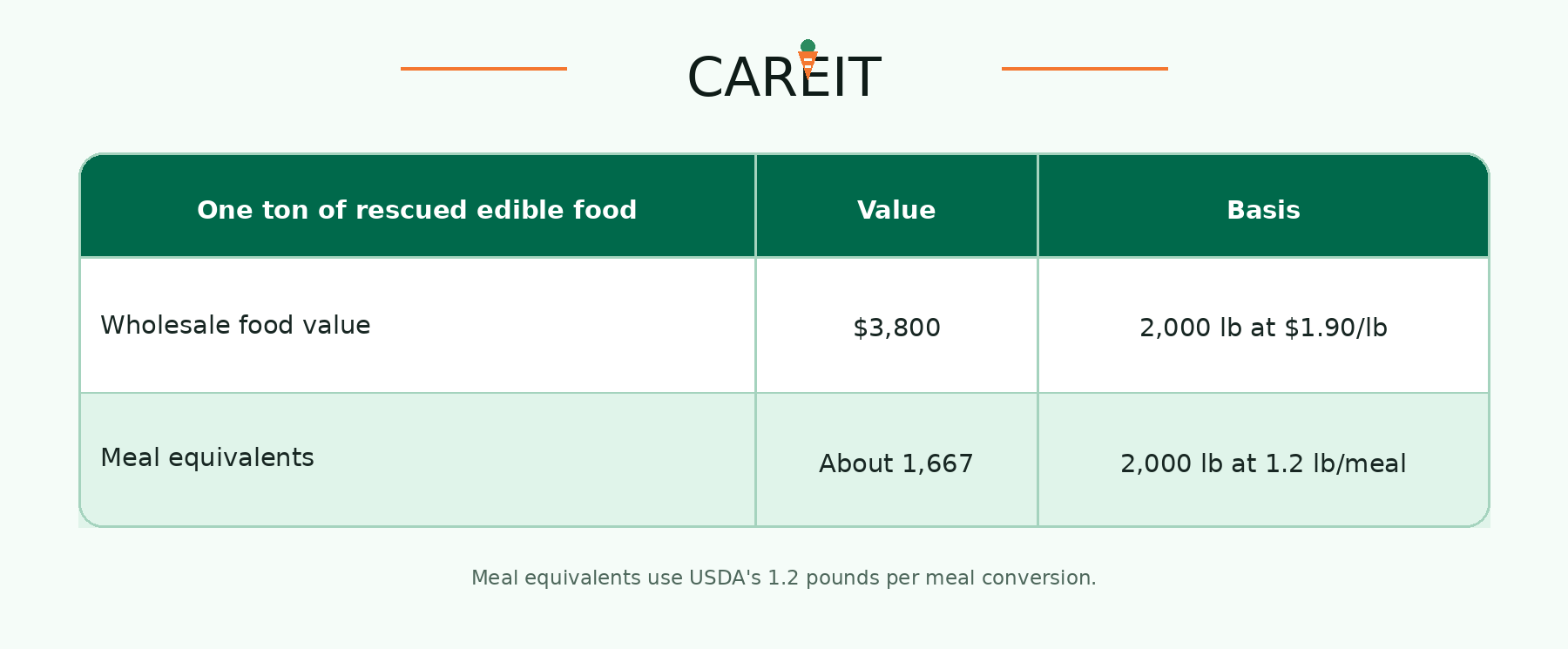
The meal equivalent calculation is 1.2lbs per meal (USDA methodology).
These figures illustrate the potential economic and social value of food recovery schemes.
For councils, it's an opportunity to look beyond traditional waste management metrics and consider how recovered food can also be a community asset.
In fact, applying the same methodology to Washington's 78,012-ton 2025 edible food recovery goal would yield circa $296m in wholesale food value and circa 130m meal equivalents.
These figures are estimates derived from published benchmarks rather than actual based on published benchmarks, not measured statewide recovery outcomes.
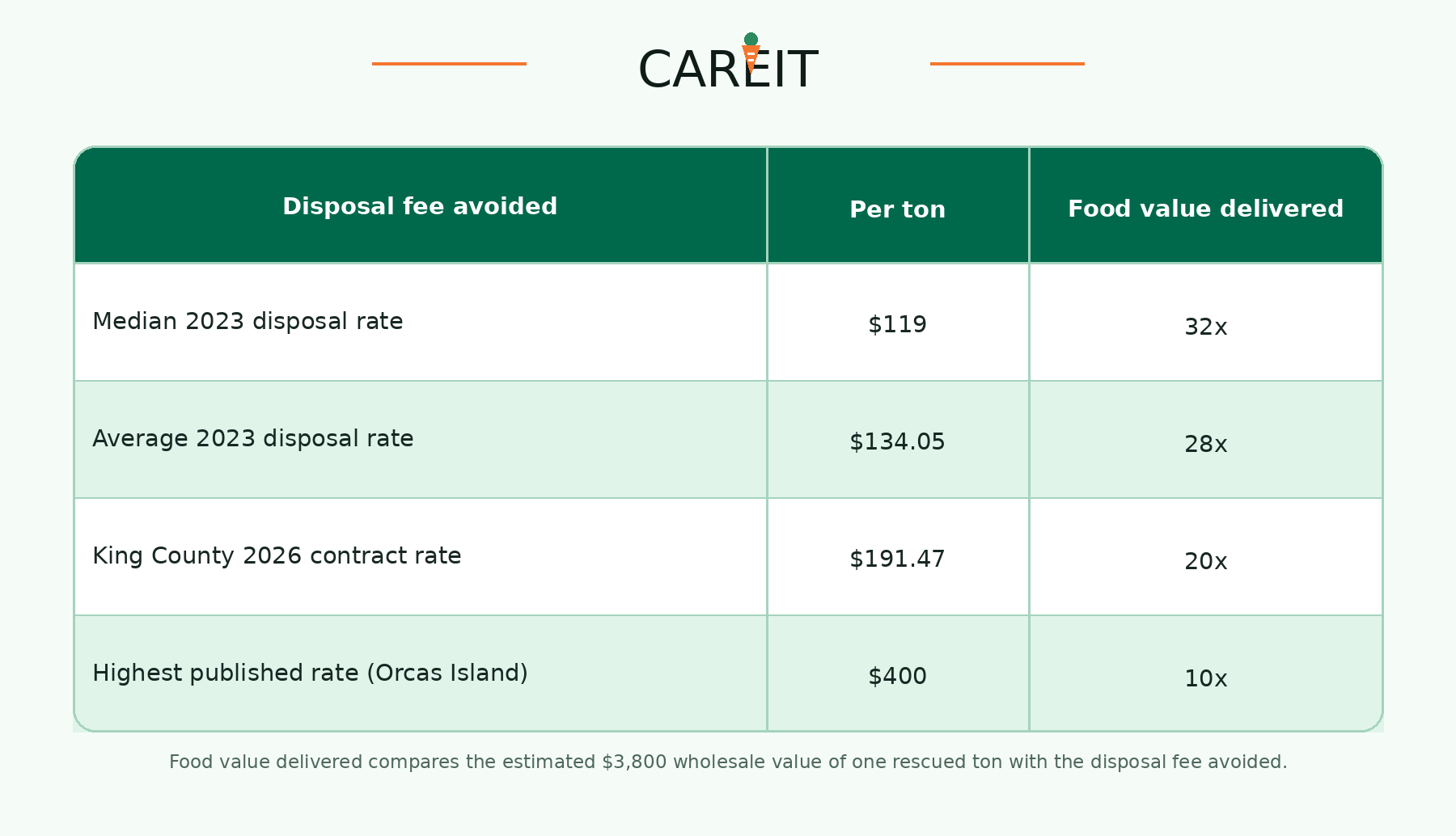
When compared with Washington’s published disposal rates, the wholesale value of a rescued ton represents approximately:
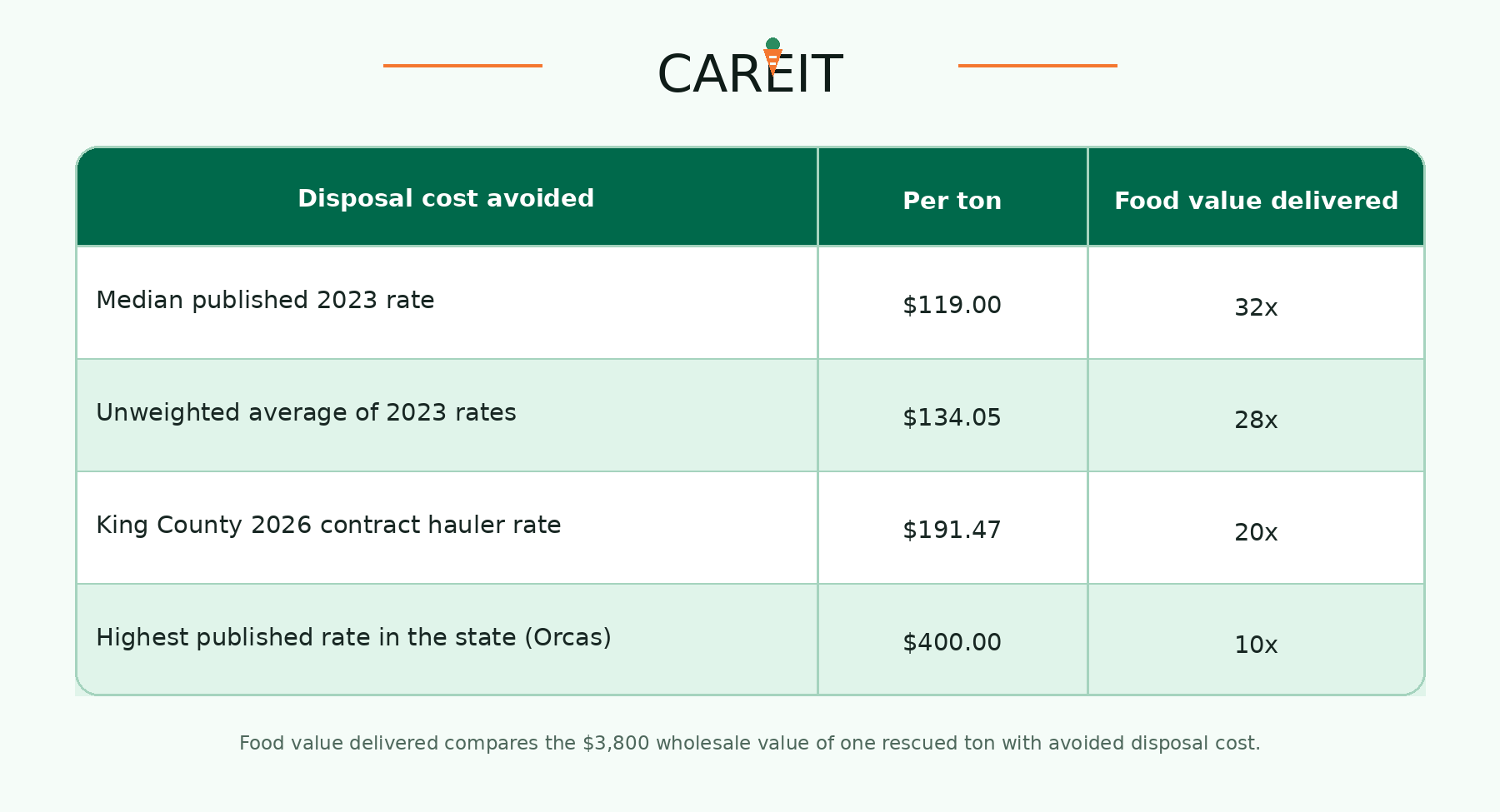
For every $1 Washington saves on disposal costs by rescuing a ton of edible food, it's delivering $20 to $30 in wholesale food value to the people who need it.
Applying the same methodology to the state's ~78,012-ton recovery target would be circa $296m in wholesale food value and circa 130m meal equivalents.
These figures are estimates based on published benchmarks rather than actual measured statewide recovery outcomes.
For local authorities, this opens the door to viewing recovered food value in a much broader context than standard waste management figures. This creates an opportunity to look beyond traditional waste management metrics and consider the broader value of recovered food.
Why the Economic Case for Food Recovery Holds Up
One of the biggest questions surrounding food recovery in Washington is how much it actually costs nonprofit organizations to collect, transport, and redistribute surplus food.
While there's no single figure for the cost of moving one ton of rescued food across the state, the research does look at a range of logistics cost scenarios to determine whether the economic case for food recovery still holds.
The analysis considers four scenarios:
Even in the most expensive scenario, every dollar spent on food recovery equates to roughly $6 in wholesale food value.
The findings are still very significant if you reduce the estimated wholesale value of the donated food by 75%. A rescued ton is still worth five to eight times what it would cost to dispose of it.
This sensitivity analysis reinforces an important point: while the exact operational costs of food recovery may vary across organizations and locations, the potential economic value remains substantial across a wide range of assumptions.
For cities and municipalities, it gives them yet another reason to consider food recovery as part of their wider food waste reduction strategy:
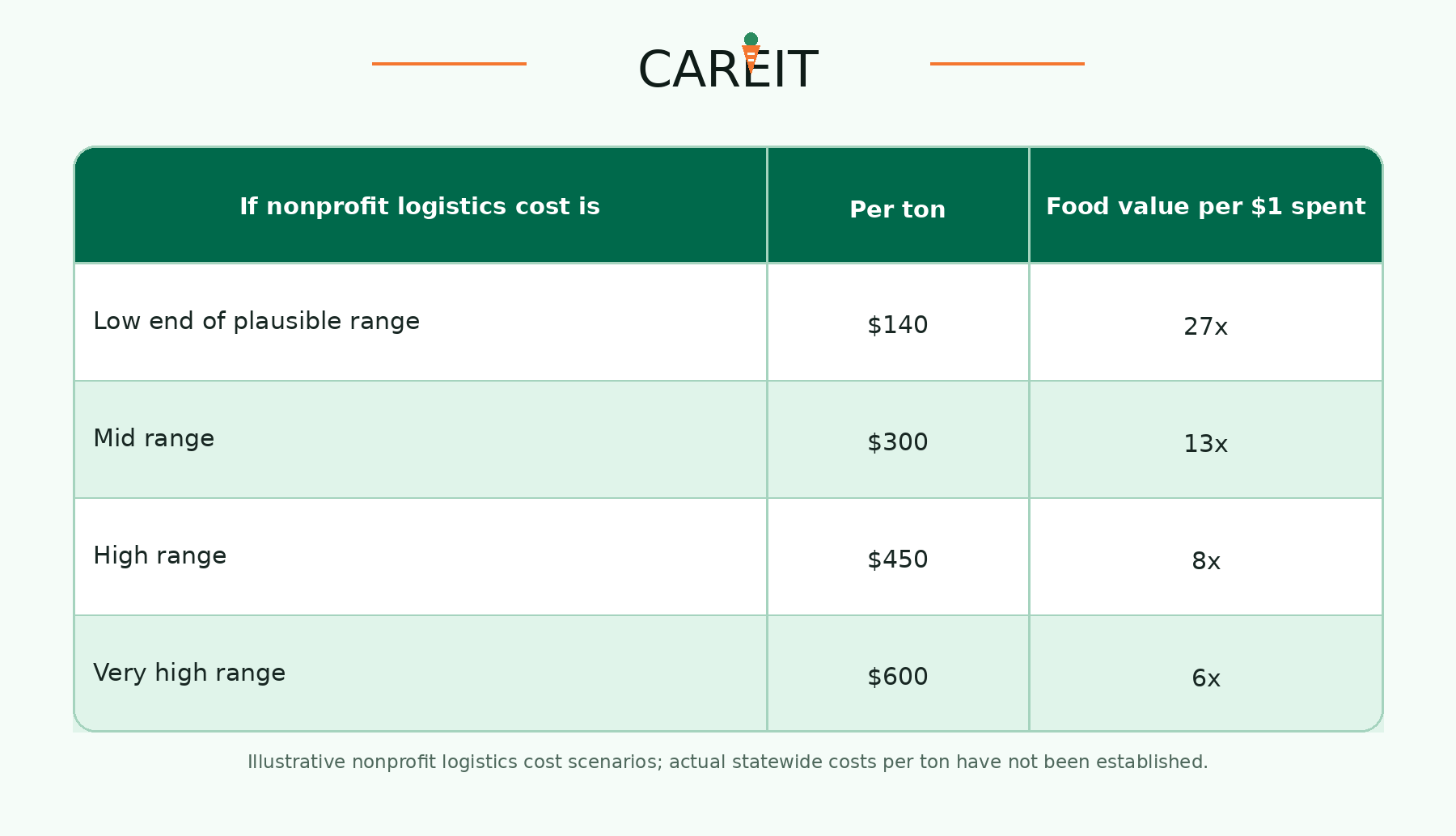
These logistics numbers are purely hypothetical, they are not actual measured Washington non-profit operating costs, but are used to demonstrate the sensitivity of the economic analysis rather than to establish a particular ROI.
What These Numbers Do and Don’t Tell Us
The wholesale value of the food donated is a useful figure to have, but it's vital to understand what that figure actually means.
The $1.90 per pound valuation is a national average based on Feeding America's donated food mix. It is an accounting value, not the price actually paid for the donated food.
Food value delivered is of course not the same as direct public budget savings. It's the amount households experiencing food insecurity would otherwise have to spend on groceries.
Not every donated pound actually gets to a person. ReFED's published methodology assumes that about 4.2% of the food that is donated to food banks is landfilled rather than distributed.
These distinctions matter when a municipality is evaluating its food recovery program and assessing its economic and social impact.
Why Food Recovery Strategies Must Consider Community Needs
An effective food recovery programme shouldn't be designed around disposal costs.
Washington's work shows an interesting relationship between landfill disposal fees and level of economic need across the counties.
When the researchers looked at county-level tipping fees in relation to SNAP participation rates, they found that the ten counties with the highest levels of SNAP participation paid an average of around $92 per ton in disposal fees.
Meanwhile the ten counties with the lowest SNAP participation were paying an average of about $161 per ton.
In other words the disposal costs were 75% higher in the counties with the lowest level of SNAP participation.
Yakima County is the state leader in both respects. It has the highest level of SNAP participation in Washington at 21.7% and the lowest published disposal fee at $44 per ton.
San Juan County is the other way around, with the lowest SNAP participation rate (5.1%) and the highest published disposal fee ($400 per ton).
This points to a significant issue for the municipal food recovery programme.
If cities are only looking at the cost of disposal when it comes to food recovery, then they may well be missing the communities where the economic need is most acute.
SNAP participation is a proxy for economic need rather than a direct measure of food insecurity. That said, the comparison does illustrate why municipalities should look at a range of indicators when determining where to invest in food recovery.
Cities can strengthen their strategies by combining:
● Local food insecurity data.
● Community demographics and economic indicators.
● Food donation and food recovery volumes.
● The location and size of the not-for-profit organizations.
● Access to the transport and food distribution infrastructure.
By understanding where surplus food is generated and where community needs are, the municipality can develop a more targeted and equitable food recovery network.
The bottom line is that an effective food recovery programme will strike a balance between operational efficiency and community impact. The areas delivering the biggest savings in terms of food disposal are not necessarily the areas where the greatest need for food assistance exists.
The Broader Community Impact of Food Recovery
Food recovery creates value that goes well beyond landfill diversion and disposal savings.
For households experiencing food insecurity, access to recovered food can help to reduce grocery bills and provide an extra resource for other basic needs.
Feeding America's Map the Meal Gap estimates that some 1,136,570 Washington residents (14.3% of the state's population) experienced food insecurity.
The estimated annual food budget shortfall was in the region of $850m.
The same study puts the average meal cost at $3.94.
At the same time a CDC published study estimated that food insecure adults spend some $1,834 more per year on healthcare than food secure adults. Applied to the Washington food insecurity numbers that comes to an estimated $1.04 billion in associated healthcare costs per year.
These figures help demonstrate the sheer scale of food insecurity and its economic ramifications.
For context, Washington's ~78,012-ton edible food recovery goal is roughly 130 million meal equivalents.
Using the state's estimated average meal cost of $3.94, those meals would equate to approximately $512m in food value at meal cost, compared to the estimated $850m annual food budget shortfall.
These figures differ and should not be read as equivalent financial savings or as evidence that food recovery would close the food budget gap.
Nevertheless the comparison does underline the scale of food recovery in relation to the problems facing communities.
For the municipality, it underlines the importance of linking food waste reduction with wider community food access strategies.
Food recovery is not a panacea for federal nutrition assistance or other food security programs. It is rather a way of making better use of food that's already in the system.
Why Food Rescue and Composting Should Work Together
Building an effective food recovery programme doesn't mean getting rid of composting.
In fact both are absolutely essential as part of a full food waste management strategy.
Of the roughly 1.2 million tons of food waste generated in Washington each year, some 390,063 tons are edible. The other 770,000 tons are predominantly trimmings, scraps and spoilage, which are not recoverable for human consumption.
These materials all require different solutions.
The EPA's Wasted Food Scale puts food waste prevention first, then looks at donation and upcycling as options. Composting and anaerobic digestion are the appropriate routes for organic material that can't be prevented or recovered for consumption.
The principle is straightforward:
Edible surplus food should be recovered for human consumption where possible. Food scraps and the like should go to appropriate organic waste management solutions.
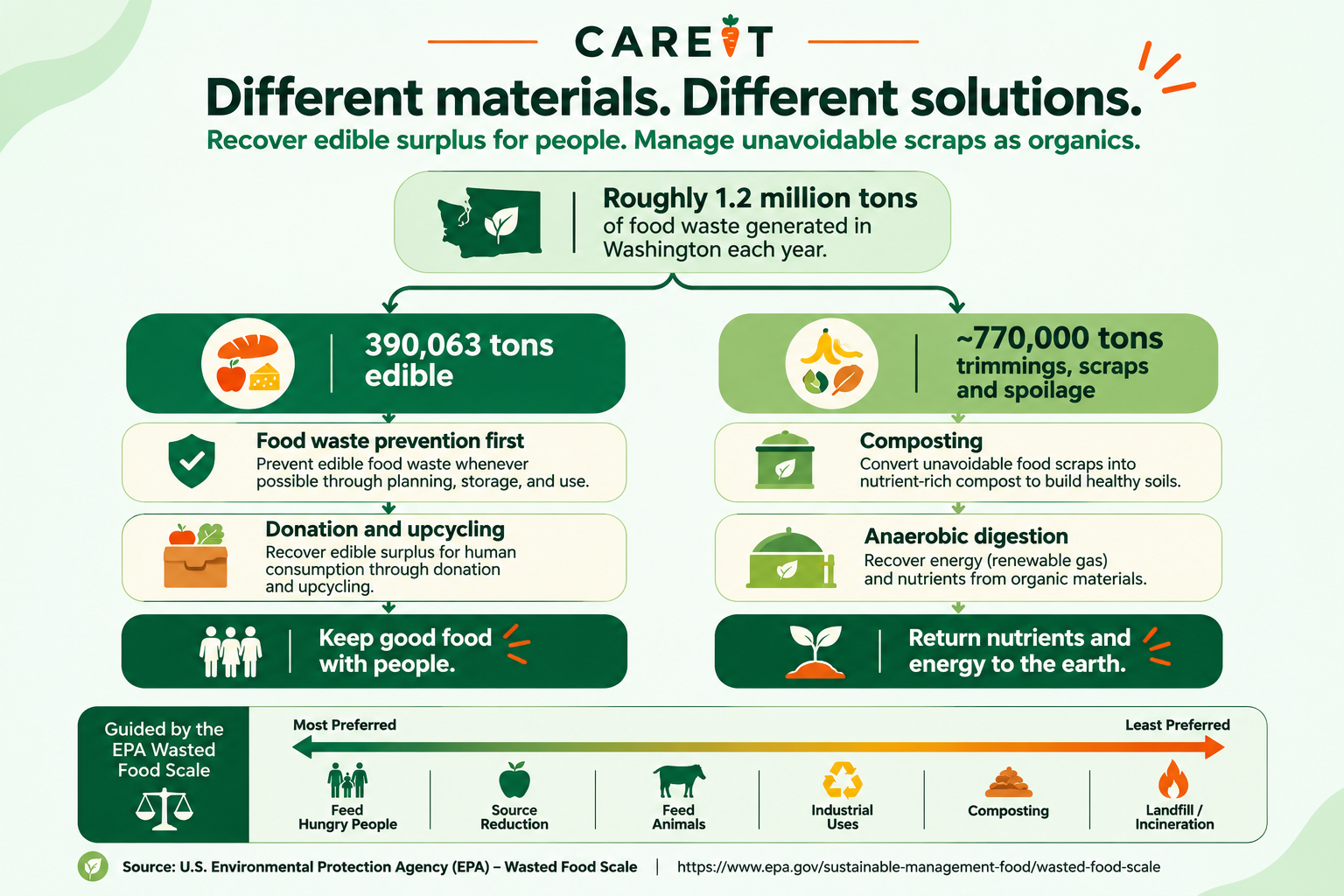
Food recovery and food composting are therefore complementary rather than competing approaches.
The challenge is ensuring that the right decision happens at the right time.
In many food businesses, surplus food decisions are made under time pressure, and there's often no process to identify surplus food, contact non-profit partners, arrange pickups, or document where the food actually goes.
Without any co-ordination, edible food would end up in the same waste stream as the stuff that can't be recovered.
This is where better food donation infrastructure and technology is absolutely essential.
Cities need systems in place to identify surplus food, link donors with organizations that are able to take it and to ensure that food which is unsuitable for human consumption gets to the right organic waste stream.
Both destinations are important. The opportunity is to get the right type of material to the right destination.
The Role of Technology and Data in Food Recovery
Building a successful food recovery network is about far more than just good partnerships. Cities also need visibility into how their programmes operate.
Without the right data, councils will have no idea how much food is actually being recovered, which businesses are getting involved, where the food is going and whether they're in fact achieving their aims.
Washington's Use Food Well Washington Plan identifies improved food donation transport and greater use of food waste and wasted food data tracking as key recommendations.
These priorities underscore the need for improved coordination and reporting across the various food recovery networks.
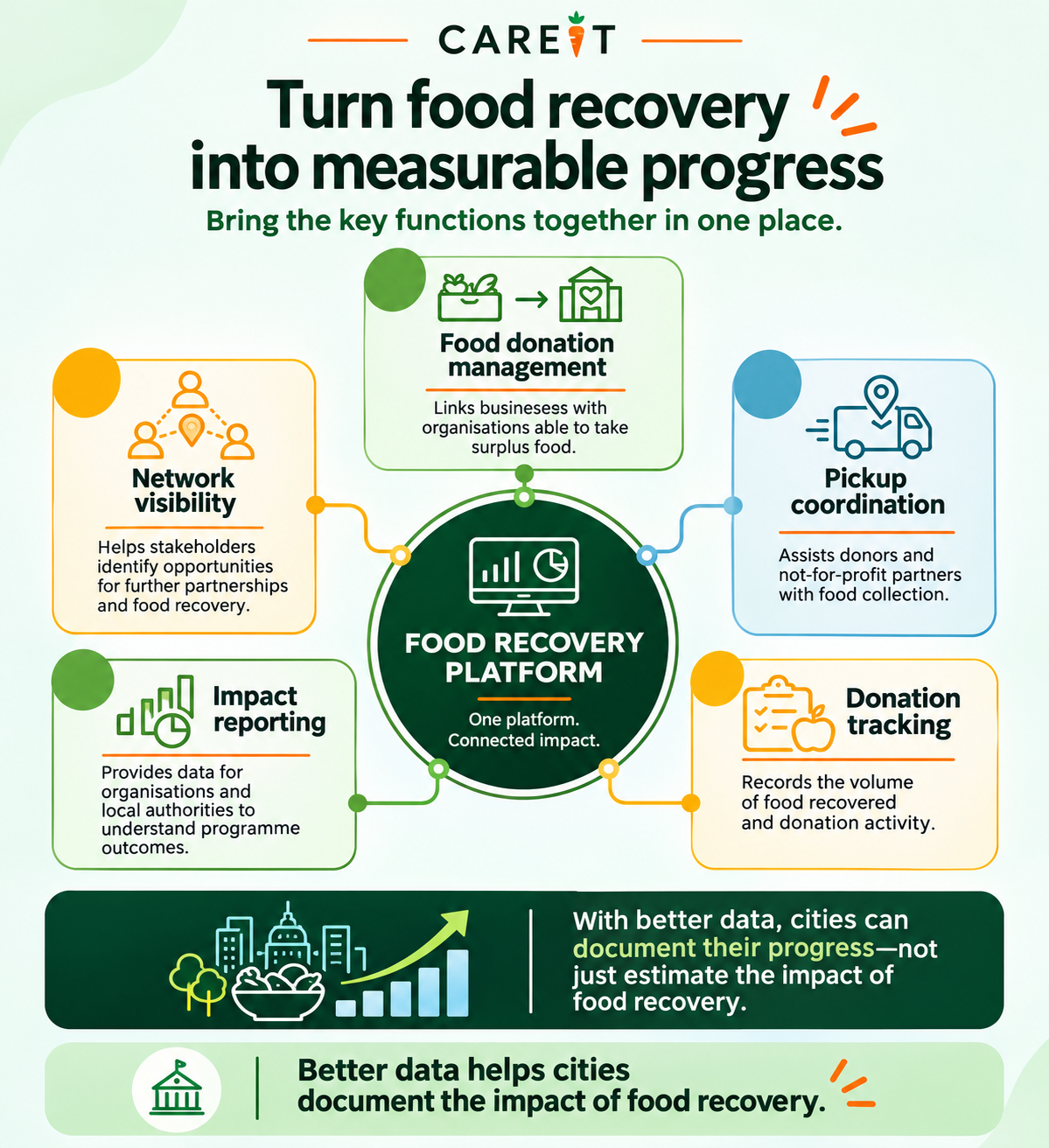
Technology can be used to help the council deal with these issues by bringing the key functions together in one place.
For example, food recovery platforms can support:
● Food donation management: linking businesses up with the organizations that can take the surplus food.
● Pickup coordination: assisting donors and the not-for-profit partners with the coordination of food collection.
● Donation tracking: tracking the volume of food recovered and the donation activity.
● Impact reporting: providing the data that enables organizations and local authorities to understand the outcomes of the programme.
● Network visibility: enabling stakeholders to identify opportunities for further partnerships and food recovery.
With better data cities can go beyond just estimating the impact of food recovery and start to actually document their progress.
This is of particular relevance to municipalities as they work towards food waste reduction targets, sustainability objectives and community food access goals.
Data tracking also enables local governments to identify operational gaps, assess participation levels, and determine where further resources or additional transport capacity might be required.
Technology doesn't replace the relationships and the infrastructure that are required to move the food. It's about coordinating the various elements of that process and making it more visible and measurable.
As Washington’s research suggests, tracking is not simply an administrative task. It underpins progress evaluation and more informed decisions about food recovery investments.
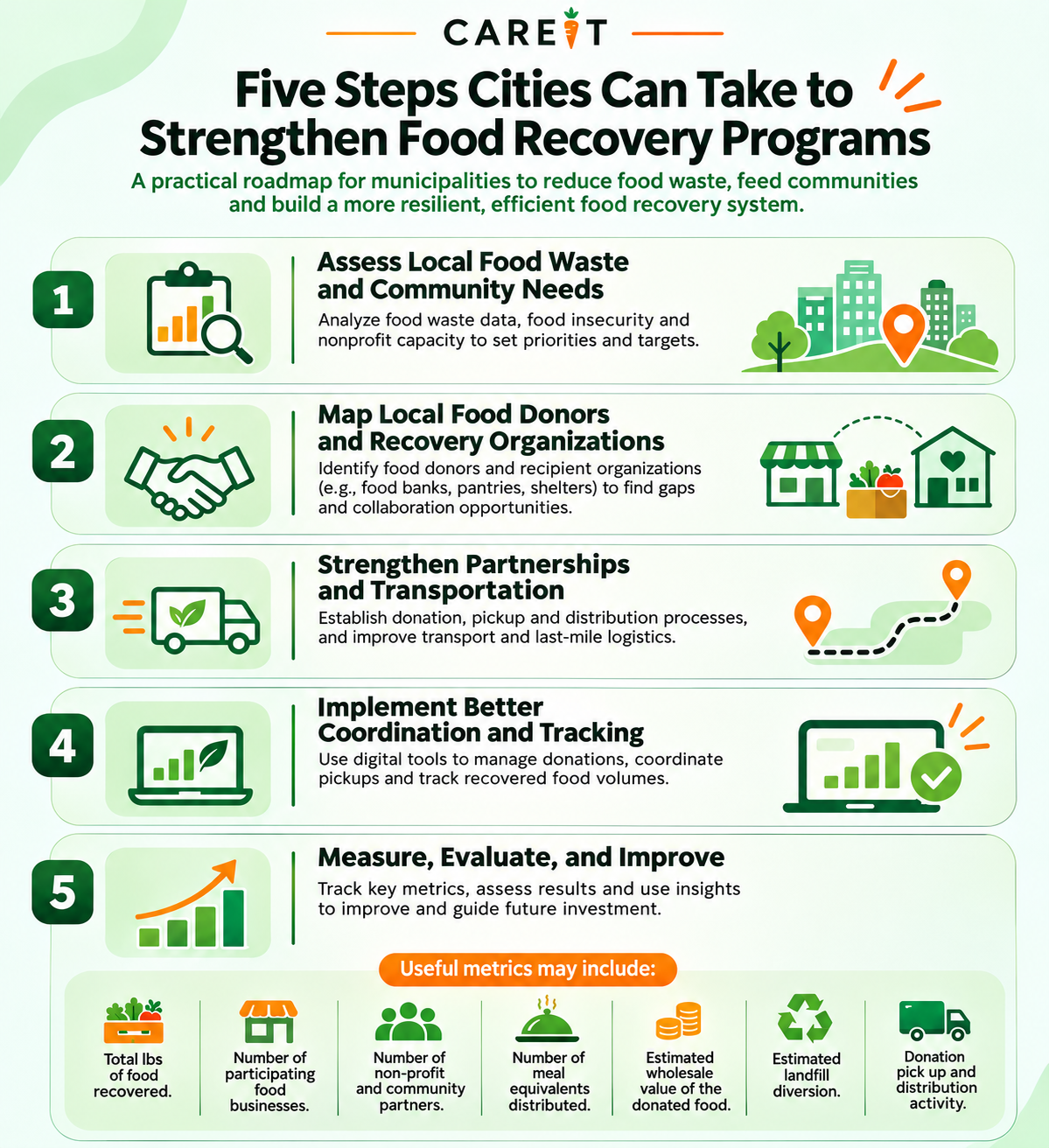
Five Steps Cities Can Take to Strengthen Food Recovery Programs
For any municipality looking to improve on an existing initiative or develop a new food recovery program, the following steps provide a practical starting point.
1. Assess Local Food Waste and Community Needs
Start by working out where the surplus edible food is being produced and where the food assistance is most required.
Review available food waste data, local food insecurity indicators, business activity, and the capacity of existing nonprofit organizations.
This baseline can help cities to identify their priority areas and set realistic recovery targets.
2. Map Local Food Donors and Recovery Organizations
Identify potential food donors (restaurants, grocery stores, hotels, food distributors, institutional kitchens etc.)
At the same time, map food banks, food pantries, shelters, and other organizations that can receive and distribute donations.
Understanding the local network is key to spotting the gaps and opportunities for collaboration.
3. Strengthen Partnerships and Transportation
Establish clear processes for food donations, communication, pickup scheduling and distribution.
Cities can be a catalyst for bringing together businesses and not-for-profits as they look at opportunities to improve transport and last mile logistics.
Reliable transport is obviously of the utmost importance for an organization that is operating with very limited resources and capacity.
4. Implement Better Coordination and Tracking
Use digital tools to help manage food donations, coordinate pickups, and record recovered food volumes.
Having good records enables you to monitor participation, spot any operational problems and report on outcomes.
Municipalities should be looking at systems that enable all the stakeholders to get involved and share the relevant information.
5. Measure, Evaluate, and Improve
Establish key performance indicators to measure the success of food recovery initiatives.
Useful metrics may include:
● Total lbs of food recovered.
● Number of participating food businesses.
● Number of non-profit and community partners.
● Number of meal equivalents distributed.
● Estimated wholesale value of the donated food.
● Estimated landfill diversion.
● Donation pick up and distribution activity.
Regular reporting enables the municipality to understand what's working, what isn't and where improvements can be made and to communicate the value of the work to stakeholders.
Most importantly, it provides a basis for building successful programmes and making data-driven decisions about future investment.
Building More Sustainable and Connected Communities
Food recovery is an opportunity for cities to deal with a number of issues in a more coordinated way.
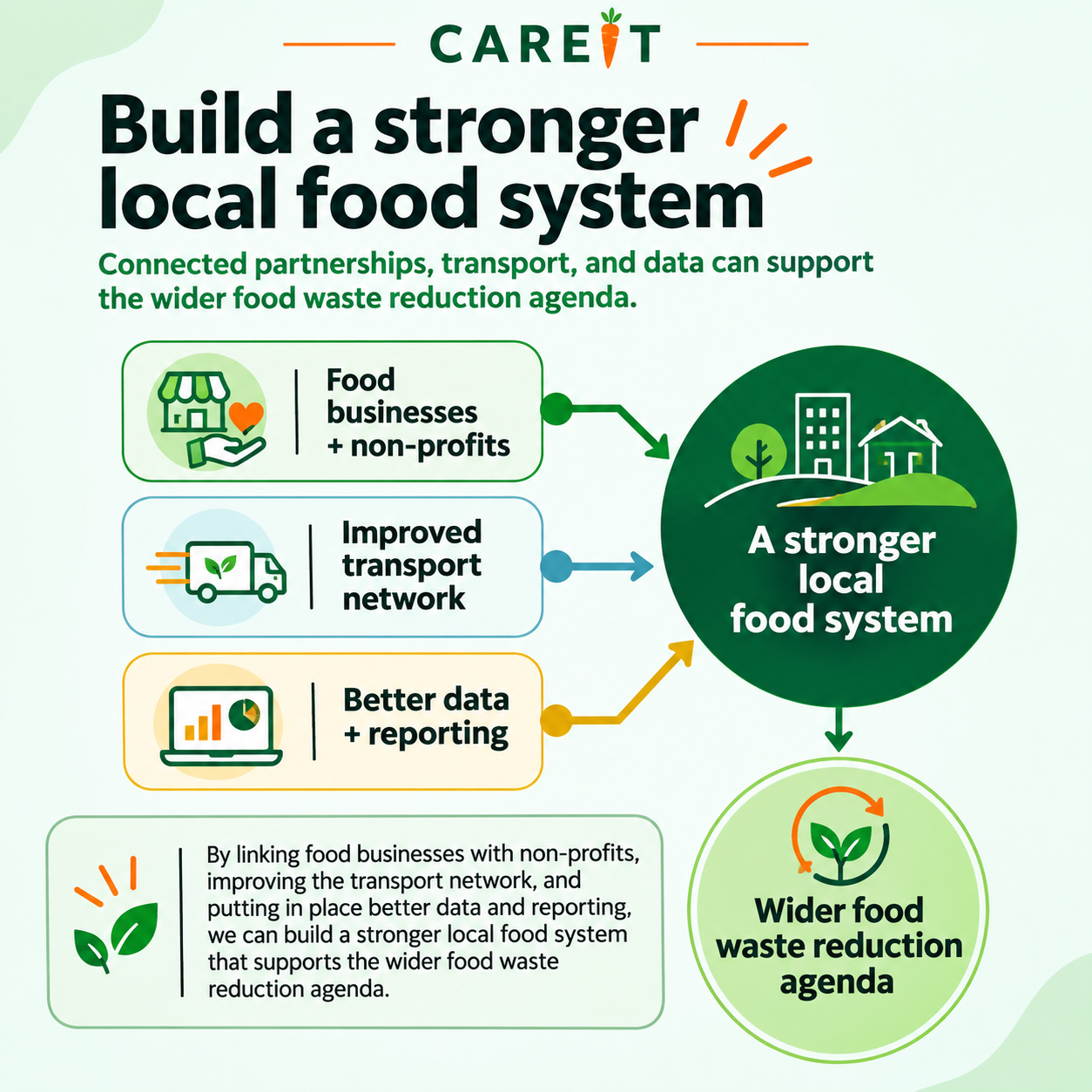
By linking food businesses with non-profits, improving the transport network, and putting in place better data and reporting, we can build a stronger local food system that will, in turn, support the wider food waste reduction agenda.
Washington's work shows that the value of rescued food is much more than just the avoided disposal charge. It's the value of the food itself, the value of being able to support food insecure households and the value of making better use of the resources that are already in the food system.
It also serves as a useful reminder for municipalities that food recovery programs don't work by simply having individual businesses make donations. They require the coordinated effort of a full network of businesses, non-profits, transport partners and local government stakeholders.
At Careit, we believe technology plays an important role in making that possible.
Careit connects food donors with food recovery organizations, enabling more effective food donation networks and helping stakeholders manage and track their recovery.
But effective food recovery is more than just connecting up donors and charities. It requires a thoughtful, end-to-end approach that covers every stage of the process, from identification through to distributing surplus food and coordinating donations through pickups, distribution, and impact tracking.
Careit takes this bigger picture into account, helping stakeholders anticipate and address potential operational bottlenecks so food recovery networks can operate more efficiently and consistently.
For cities and municipalities the first step in building a stronger food recovery ecosystem is to connect the right people, put in place the right processes and have the data to measure progress.
It's not just about reducing waste. A more sustainable food system means ensuring more of the food we already produce reaches the people who need it.
Ready to strengthen your city's food recovery network?
Discover how Careit can connect food businesses and nonprofit organizations, streamline food donation coordination, and support more effective food recovery through an end-to-end approach.