
For many businesses, surplus food feels like a loss. Whether it’s overstock, mislabeled packaging, or items nearing their "sell-by" date, throwing away "apparently wholesome food" isn't just a waste of resources—it's a missed financial opportunity.
By using Careit, your business can transform surplus food into a significant tax break. Here is how you can work with your CPA to turn your donation data into a specialized federal tax deduction.
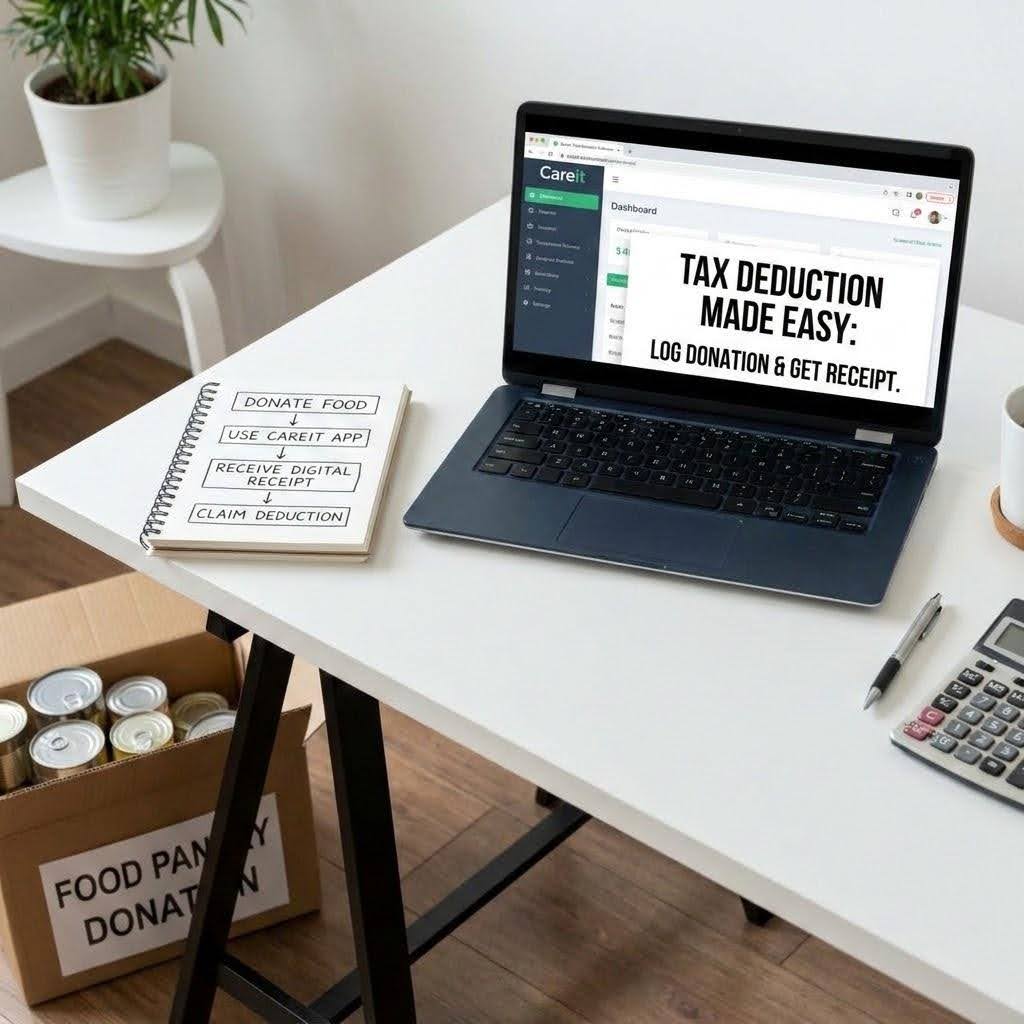
The Secret Weapon: The Enhanced Tax Deduction
While most charitable contributions are limited to the "basis" (cost) of the item, the IRS allows businesses that donate food to qualified nonprofits to claim an Enhanced Tax Deduction (Ackerman & Auten, 2011). This deduction allows you to claim more than just what you paid for the food—it factors in a portion of your lost profit (Ackerman & Auten, 2011).
The IRS Formula
To find your exact deduction, the IRS recommends a specific calculation. You are entitled to the lesser of these two amounts:
Cost of Goods Sold (Basis) + 50% of the Appreciation (The "Appreciation" is the difference between the Fair Market Value and the Cost).
2x the Cost of Goods Sold (Basis).
Example: You donate bread that cost you $1.00 to make (Basis) but sells for $3.00 (Fair Market Value).
The appreciation is $2.00.
Half of that appreciation is $1.00.
Formula 1: $1.00 (Cost) + $1.00 (Half appreciation) = $2.00 deduction.
Formula 2: 2x Cost ($1.00) = $2.00 deduction.
In this case, you deduct $2.00—doubling the deduction you would get for a standard inventory donation.
What Costs Can You Include?
For a business donating food to a qualified charity, the cost basis is typically the inventoriable carrying cost of the food, which includes direct costs (ingredients) and, in some cases, allocated indirect costs. Under the enhanced deduction rules (IRC Section), businesses can often deduct more than just the cost basis, but knowing the cost basis is essential for calculating that enhanced deduction.
What Constitutes Cost Basis
Purchased Food: The cost basis is the price paid to acquire the food.
Produced/Prepared Food: The basis includes the cost of ingredients and, for many businesses, mandatory allocations for indirect costs.
Excluded Costs: Generally, labor, overhead, and other operating expenses are not included in the cost basis of the food itself.
Cash-Method Farmers/Businesses: If you do not account for inventories and are not required to capitalize indirect costs, you can elect to treat the basis as 25% of the fair market value (FMV) of the donated food. (Cherry Bekaert Advisory LLC, 2024)
How Careit Simplifies the Process
The biggest hurdle for CPAs at tax time is documentation. Careit acts as your digital paper trail.
Automated Record Keeping: Every time you post a donation on Careit and it is claimed by a nonprofit, the app logs the weight, food type, and date.
Donor Substantiation: To claim this deduction, the IRS requires a "written acknowledgment" from the charity stating the food will be used solely for the care of the "ill, needy, or infants" (Southern Business Review, 2008). Careit’s reporting provides the digital proof of transfer and recipient status your CPA needs.
Valuation Reports: You can export your donation history to provide your CPA with a clear list of what was donated, making it easy for them to apply the Fair Market Value (FMV) at the time of donation.
The "Three-Year Rule" for Donated Property
If a nonprofit receives a non-cash donation and then sells or disposes of it within three years, they must report that "disposition" to the IRS using Form 8282.
When is Form 8282 NOT required?
Your organization (or the charity you donated to) can skip this form in two specific scenarios:
Low Value: The items are worth $500 or less.
Mission-Aligned Use: The property is distributed directly for charitable purposes (for example, a food bank giving your donated pallets of cereal directly to families in need).
Filing Deadlines & Penalties
If the form is required, the timeline is strict:
125 Days: The charity must file Form 8282 with the IRS within 125 days of getting rid of the property.
Donor Notification: The charity must send a copy of this form to the original donor.
Consequences: Failing to file this can result in IRS penalties for the organization.
Why this matters for your business: If you donate surplus food via Careit and the nonprofit distributes it to the hungry (a "charitable purpose"), they do not need to file this extra paperwork, regardless of the food's value. This makes food donation much simpler than donating other types of business assets like vehicles or equipment.
Best Practices for Business Tax Deductions
Ensure "Apparently Wholesome" Quality: Under the Bill Emerson Good Samaritan Act, food must meet all quality and labeling standards imposed by federal, state, and local laws, even if it is not readily marketable (University of Arkansas, 1996).
Verify Non-Profit Status: Only donations to 501(c)(3) organizations qualify for the enhanced deduction (Southern Business Review, 2008). Careit can help your corporation verify the status of nonprofits on the platform for you.
Don’t Sell the Food: The recipient organization cannot charge the end-user for the food or trade it for services (Southern Business Review, 2008).
Timing is Key: Federal law allows you to deduct up to 15% of your business's net income for food donations annually (Ackerman & Auten, 2011). Excess deductions can often be carried forward to future years.
References
Ackerman, Deena & Auten, Gerald, 2011. "Tax Expenditures for Noncash Charitable Contributions," National Tax Journal, National Tax Association;National Tax Journal, vol. 64(2), pages 651-687, June. https://ideas.repec.org/a/ntj/journl/v64y2011i2p651-87.html
Southern Business Review. (2008). Cash Flows from In-Kind Charitable Contributions: They're Worth More than You Think!. Southern Business Review, 33(2). https://digitalcommons.georgiasouthern.edu/cgi/viewcontent.cgi?article=1103&context=sbr
University of Arkansas School of Law. (1996). The Legal Guide to the Bill Emerson Good Samaritan Food Donation Act. http://law.uark.edu/service-outreach/food-recovery-project/Legal-Guide-to-the-BEA-Haley-Final.pdf
Cherry Bekaert Advisory LLC. (2024). Enhanced Deduction for Donations Made by Restaurants and Food Retailers